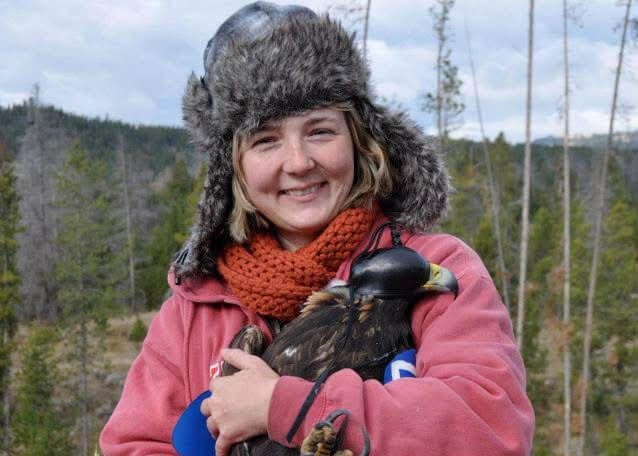
Liz grew up on a small horse farm in New Jersey. A lifelong animal lover and nature enthusiast, she knew from an early age that she wanted to work outdoors as a steward for wildlife and natural landscapes. She was a member of the first graduating class of the Marine Academy of Technology and Environmental Science (MATES), a full-time vocational school for high school students aspiring to become environmental professionals. She went on to Delaware Valley University in 2010, where she pursued a B.S. in Conservation and Wildlife Management. While there, she completed her first internship at the Wetlands Institute in Stone Harbor, New Jersey. Initially leaning toward a career in herpetology, she was drawn into the program for its extensive work in diamondback terrapin conservation; however, she ultimately completed an independent study on least terns, which are state-listed as endangered. From there, Liz’s interests shifted toward ornithology.
After graduating from college in 2010, she began an internship at Edwin B. Forsythe National Wildlife Refuge in Galloway, New Jersey. While there, Liz was introduced to the world of birdwatching by fellow interns and began keeping a life list. When she wasn’t monitoring beach-nesting birds, banding waterfowl, engaging in public outreach, or battling invasive vegetation, Liz could be found on Forsythe’s wildlife drive, searching the impoundments and adjacent salt marsh for birds. More than 15 years later, the refuge remains one of her favorite year-round birding spots.
Eager to build both her resume and her life list, Liz went on to complete several seasonal field positions throughout the eastern United States. She performed call-back surveys for secretive marsh birds and radio-tracked king rails along the Gulf Coasts of Louisiana and Texas; radio-tracked rusty blackbirds in the Great North Woods of New Hampshire; assisted with heron and egret research and marsh rabbit radio-tracking in southern Florida; conducted beach-nesting bird monitoring in Cape Cod, Massachusetts; completed extensive waterbird surveys in coastal Virginia and North Carolina; and participated in marsh bird surveys in Delaware. She also ventured west to Montana, where she spent a season counting migratory raptors. In her free time, she continued birding; while interning in Cape Cod, she participated in the World Series of Birding and volunteered as a pelagic seabird surveyor on whale-watching vessels in the Stellwagen Bank Marine Sanctuary.
Liz eventually returned full-time to New Jersey, where she earned a Professional Science Master’s in Environmental Science from Stockton University; her capstone focused on habitat management for grassland birds. She found full-time employment at an environmental consulting firm, where she recently celebrated her ten-year anniversary. In addition to wetland delineations, freshwater mussel surveys, ecological restoration projects, and environmental permitting, she regularly undertakes bird-related projects such as peregrine falcon monitoring, bald eagle monitoring, beach-nesting bird surveys, and various habitat assessments. When not working or hiking and birding around New Jersey and surrounding states, Liz serves as both a River Watcher and a Board of Trustees member for the Musconetcong Watershed Association. She is also a Trail Maintainer for the New York–New Jersey Trail Conference. On top of all of this, she has begun taking classes to obtain the credentials to become a state-approved forester. She resides in Warren County, New Jersey with her German Shepherd mix and three cats.